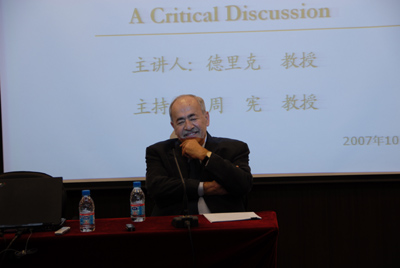
2007年10月18日, 香港中文大学历史系阿里夫·德里克(Arif Derick) 教授做主题为"Contemporary Perspectives on Modernity:A Critical Discussion"的名家讲坛讲座。由周宪院长主持,许倬云先生也一起聆听了演讲。
Abstract:
Contemporary Perspectives on Modernity: A Critical Discussion
The turn away from revolutionary socialism toward greater accommodation of capitalism has created a crisis in historiography in both the United States and China, which has been expressed through debates over revolution and modernization as alternative paradigms. In the meantime, the increased attention to globalization since the 1990s has changed the meanings of both revolution and modernization. Ironically, the globalization of capitalism and cultural practices associated with capitalism has resulted in the resurgence of cultural pasts that were relegated to oblivion under both revolution and modernization. This has created a condition that I have described as "global modernity," leading to conflicting claims over modernity and the relevance of different pasts. The result is a "clash of civilizations," or conflicts over civilizational claims on modernity, which has once again opened up the concept of modernity to renewed speculation. I will discuss some recent efforts to this end, and conclude by offering a different way of thinking about modernity that accounts for these contradictions. I will argue that we think of the unfolding of modernity in three phases: (a)Modernity as a Eurasian/African product, which led to different formations in different locations, (b)A Eurocentric modernity that colonized the world, empowered by capitalism and nationalism which were the unique products of Europe, (c) A post-Eurocentric global modernity that is articulated in conflicting claims on modernity, but within a political economic and ideological field that has been shaped by colonial modernity.
(1)Modernity as Historiographical Problem
(2)Globalization and the Re-writing of Modernity
(3)Modernity, Capitalism, Modernization and Revolution
(4)Concluding Observations


